Showing posts with label Canaan. Show all posts

Sunday, April 5, 2015

Egyptian Artifacts Salvaged from Robbed Tomb in Israel

by Megan Gannon, News Editor   

In an underground cave in Israel, archaeologists have unearthed 3,000-year-old Egyptian artifacts that had been spared by tomb robbers.
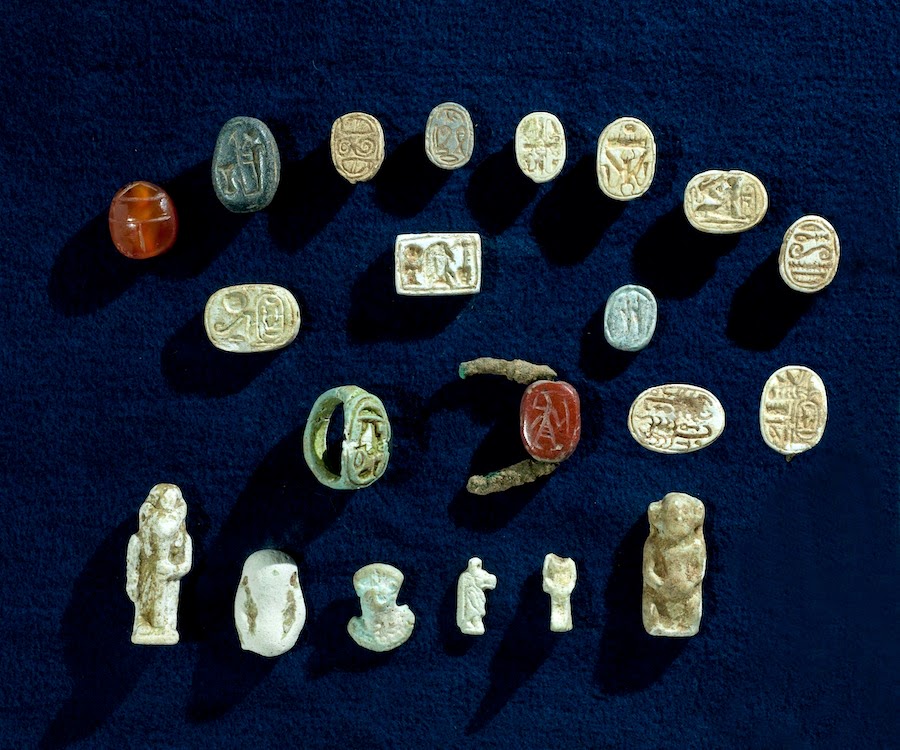

courtesy of the Israel Antiquities Authority

Inspectors with the Israel Antiquities Authority's (IAA) Unit for the Prevention of Antiquities Robbery say they found pickaxes and other signs of looting in a cave near Kibbutz Lahav in southern Israel.

Upon further investigation, the excavators discovered a hoard of ancient artifacts. IAA officials say they don't yet know how the cave was used or why these objects were placed there, but they found several intact ceramic pots; jewelry made of bronze, shells and faience; oil lamps; small amulets; alabaster jars; cosmetic vessels; and Egyptian scarab seals that date back to the 15th and 14th centuries B.C.

"During this period, Canaan was ruled by Egypt," Daphna Ben-Tor, curator of Egyptian archaeology at the Israel Museum, explained in a statement from the IAA.

"The names of kings appeared on some of the seals," Ben-Tor added. "Among other things, we can identify a sphinx lying opposite the name of the pharaoh Thutmose, who reigned from about 1504-1450 B.C. Another scarab seal bears the name of Amenhotep, who reigned from about 1386-1349 B.C. Still another scarab depicts Ptah, the principal god of the city of Memphis."

The announcement was timed just before Passover, the Jewish holiday celebrating the biblical story of the Israelites leaving slavery in Egypt. There's no solid archaeological evidence to back the Exodus as a historical event, and these newfound artifacts don't offer new insights on that front. But from these findings, historians could potentially "learn about the great influence of the Egyptian administration and culture on the inhabitants of the Land of Israel during the Late Bronze and Iron Age periods," Eitan Klein, an archaeologist with the IAA, told Live Science.

Source: http://www.livescience.com/50335-egyptian-artifacts-salvaged-from-robbed-tomb.html

Tuesday, June 17, 2014

Archaeologists Return to Excavate Ancient Jaffa

Investigations include further excavations at the famous Egyptian Gate, a search for the ancient harbor, and exploration of the ancient destruction level at the Lion Temple.

Teams of archaeologists, students and volunteers will return this month to the site of ancient Jaffa on the central coast of Israel to pick up where they left off in 2013, when they uncovered more of the sensational evidence of a fiery destruction at the site's ancient Amarna period New Kingdom Egyptian fortress gate. The continuing investigations will also include new elements -- the search for the ancient harbor complex, and excavation of evidence of a 14th century B.C. destruction layer at the remains of the site's Lion Temple. 

Under the direction of project co-directors Aaron Burke, Associate Professor of the Archaeology of Ancient Israel at the University of California, Los Angeles, and Martin Peilstöcker of the Israel Antiquities Authority, one team will continue the excavations at the famous fourteenth century B.C. Egyptian fortress gate complex, where in 2013 they uncovered the stark remains of an extensive violent destruction.

Excavations in 2012 first revealed the evidence, with clues to its extent indicated when excavators discovered a commemorative scarab of Amenhotep III dated to the mid-fourteenth century B.C., found within the upper destruction layers and apparently fallen from what the archaeologists interpreted as a second story administrative office floor. A year later, in 2013, they exposed the city gate’s passageway below more than 1.5 meters of destruction debris. The finds included arrowheads, a spearhead and lead weight, decorative ivory inlays, numerous charred seeds, a number of ceramic vessels, antlers from deer, and nearly two dozen cedar timbers thought to have once made up the gate’s roof and upper story. The seeds, identified as those of barley, olive pits, grape pips, and chick peas were a welcome find, as they provide an insight to the foods consumed at the site.

Monday, November 11, 2013

How a Canaanite goddess conquered ancient Egypt

Brought over by mysterious conquerors and fused with a local deity, the nameless goddess was a kinder, gentler - and yellow - goddess.

By Julia Fridman

Upon entering the tomb of King Thutmosis III, its excavator was greeted by a scene he hadn't expected. In addition to the typical stiff, repetitive funerary imagery of the time, the innermost sanctum of the burial chamber had a simple image of the Pharaoh suckling on a breast protruding from a tree.

The association of a tree of life with a major goddess had been all but unknown in Thutmosis’ 18th Dynasty Egypt (1479 BCE to 1425 BCE). But they were very well known in Canaan and the broader Levant.

Nude goddesses and tree symbolism began appearing as early as the Neolithic period, some 12,000 years ago in the north of Israel. Artifacts including scarab seals, jewelry, and clay figurines were found at important sites such as Lachish, Megiddo, Beit Shean, Gezer, and Nahariya, to name just a few.

By the time of the Middle Bronze Age, 4,000 years ago, they were commonplace in funerary, household and temple contexts – in the Levant. Not in Egypt.

Monday, March 4, 2013

The Egyptian Fortress in Jaffa

By Aaron A. Burke and Martin Peilstöcker   Sun, Mar 03, 2013

Archaeologists are rediscovering a Late Bronze Age Egyptian stronghold in the land of ancient Canaan.


In a very real sense, the ancient port city of Jaffa may offer a valuable historical and archaeological example of the age-old issues and dynamics that have beset occupying powers the world over for thousands of years. Archaeologists have been exploring and studying the ancient Egyptian fortress at this coastal city to obtain insights on what it was like for both conqueror and conquered when there are "strangers in the land"..........

Situated on the central coast of Israel, on the south side of Tel Aviv, and 60 km to the northwest of Jerusalem, Jaffa’s antiquity and importance as a Mediterranean port was well established before the resumption of excavations in 2008 by the Jaffa Cultural Heritage Project. While the biblical texts have served as a primary historical referent, Jaffa’s importance in other periods is much more clearly understood in classical sources including Josephus, but also even from Egyptian New Kingdom literature and administrative documents. Following excavations during the 1950s of the archaeological remains of an Egyptian fortress in Jaffa, a fortress that existed for most of the Late Bronze Age (ca. 1460 to 1130 BC), seeking to understand Jaffa’s role in the Egyptian New Kingdom imperial control of Canaan became of paramount importance.

In 2007 the Jaffa Cultural Heritage Project was established by Aaron A. Burke of the Cotsen Institute of Archaeology at the University of California, Los Angeles and Martin Peilstöcker of the Israel Antiquities Authority. The project’s overarching goal is to facilitate long-term research of Jaffa’s cultural heritage through the integration of research and salvage excavations, cultural and historical studies, and multidisciplinary scientific approaches to Jaffa’s history and archaeology. Central to this objective was the renewal of excavations on the mound of ancient Jaffa (Tel Yafo). As part of the initial phase of the project, the Kaplan Excavations Publication Initiative was conceived to provide an in-depth analysis of the unpublished excavations by the site’s most prolific excavator, Jacob Kaplan, who conducted excavations on behalf of the municipality of Tel Aviv-Jaffa and the Israel Department of Antiquities and Museums from 1955 to 1974. We present here the preliminary results of our synthesis of the results of the old excavations since the resumption of excavations in the same area in 2011 by the Jaffa Cultural Heritage Project.