By Garry Shaw 21 March 2017
Earlier this month, news of the discovery of a colossal statue of an ancient Egyptian king took the world by storm. Working deep in a water-logged pit, a joint team of Egyptian and German archaeologists discovered the eight metre-high colossus broken into two large pieces: a torso and lower part of the face, with a part of the pharaoh’s false beard present, and the top of its head, wearing a crown. These pieces have now been lifted to the surface, and taken for conservation at the Egyptian Museum in Cairo, where they will be temporarily displayed. Afterwards, the statue will be exhibited at the Grand Egyptian Museum, currently under construction at Giza and scheduled to open in 2018. Though early reports indicated that the quartzite colossus might have been erected under the famous King Ramesses II (c. 1279–1212 BC), it has since been shown to bear the name of King Psamtik I (c. 664–610 BC) of the Late Period – an arguably equally important pharaoh, though lacking the star power of the earlier, better known ruler.
The colossus was discovered in Matariya, a northeast suburb of Cairo. Now a densely packed area of apartment buildings, for thousands of years it was part of one of ancient Egypt’s greatest cities, better known today by its Greek name: Heliopolis, ‘City of the Sun’ (not to be confused with modern Heliopolis, a couple of kilometres to its east). From the beginning of Egyptian history, ancient Heliopolis was the main centre of Egypt’s sun cult, where priests worshipped the god Re, and developed myths proclaiming his temple to be built on the first land that rose from the floodwaters after creation. Ancient descriptions and depictions present it as a city of statues, obelisks (two of which are now in London and New York), sphinxes, shrines, large and elaborate temple complexes, housing, fields and farms, connected to the Nile by canal. It was a place of learning, where astronomical observations were made. Such was the city’s prestige that occasionally the office of high priest of Re was held by a royal prince.
Showing posts with label Late Period. Show all posts
Showing posts with label Late Period. Show all posts
Friday, March 24, 2017

Saturday, October 22, 2016
Two Late Period tombs discovered in Aswan
Two Late Period tombs have been uncovered near the Aga Khan mausoleum in Aswan
By Nevine El-Aref , Friday 21 Oct 2016
Two rock-hewn tombs from the Late Period (664 BC to 332 BC) have been revealed near the Aga Khan mausoleum on Aswan's west bank during excavation works carried out by the mission of Aswan Field School.
Nasr Salama, the director-general of monuments in Aswan and Nubia at the antiquities ministry, explains that the architecture of both tombs is very simple and each consists of a rectangular front hall with stairs leading to the burial shaft where remains of a sarcophagus and mummy are located.
According to Salama, the tombs are in a very bad conservation condition with plain walls without any decorations, paintings or funerary collection.
The owners of the tombs have not yet been identified but more studies and excavation inside the tombs should yield further information, he added.
Adel Tohamy, the head of the Aswan Field School said that the school aims to train junior archaeologists and restorers to use state-of-the-art techniques in excavations, restoration and documentation of monuments, as well as in archaeological surveying.
Source: http://english.ahram.org.eg/NewsContent/9/40/246263/Heritage/Ancient-Egypt/Two-Late-Period-tombs-discovered-in-Aswan.aspx
By Nevine El-Aref , Friday 21 Oct 2016
Two rock-hewn tombs from the Late Period (664 BC to 332 BC) have been revealed near the Aga Khan mausoleum on Aswan's west bank during excavation works carried out by the mission of Aswan Field School.
 |
| Photo courtesy of Aswan Field School. |
According to Salama, the tombs are in a very bad conservation condition with plain walls without any decorations, paintings or funerary collection.
The owners of the tombs have not yet been identified but more studies and excavation inside the tombs should yield further information, he added.
Adel Tohamy, the head of the Aswan Field School said that the school aims to train junior archaeologists and restorers to use state-of-the-art techniques in excavations, restoration and documentation of monuments, as well as in archaeological surveying.
Source: http://english.ahram.org.eg/NewsContent/9/40/246263/Heritage/Ancient-Egypt/Two-Late-Period-tombs-discovered-in-Aswan.aspx
Sunday, June 28, 2015
Museum Pieces - Tomb Relief
Tomb relief with an inscription in raised relief: rp´ h3tj-´ (sd3wtj) bjtj.
Titles and status were important. This relief fragment tells that the tomb owner was a nobleman, a member of the elite and a governor. The bee at the bottom of the column hints at a connection with the king, which was very prestigious.
Inventory number: MM 11433
Object: Relief
Material: Limestone; Stone
Period: 25th Dynasty (c.735-656 BC), Late Period
Dimensions: H. 36,5 cm, W. 25 cm, D. 4 cm
The ancient Egyptian Bee (hieroglyph), Gardiner sign listed no. L2, is the representation of a honeybee. The bee figures prominently throughout Ancient Egyptian history, and started in the early Protodynastic Period, for example with Pharaoh Den. His timeperiod famously produced 20 tomb-labels (tags) that recorded events, and told short stories, with the first use of hieroglyphs, that by 2900 BC time had included biliterals, some triliterals, and the Egyptian hieroglyphic uniliterals.
The form of the bee on Den's labels, and others in the timeperiod (Semerkhet), show similar form, a flying bee, at an angle. The later forms are more "horizontal, wings outspread".
Sources:
http://collections.smvk.se/carlotta-mhm/web/object/3013029
https://en.wikipedia.org/wiki/Bee_(hieroglyph)
 |
| Photocredit: Medelhavsmuseet 2013 |
Titles and status were important. This relief fragment tells that the tomb owner was a nobleman, a member of the elite and a governor. The bee at the bottom of the column hints at a connection with the king, which was very prestigious.
 |
| Photocredit: Medelhavsmuseet 2013 |
The ancient Egyptian Bee (hieroglyph), Gardiner sign listed no. L2, is the representation of a honeybee. The bee figures prominently throughout Ancient Egyptian history, and started in the early Protodynastic Period, for example with Pharaoh Den. His timeperiod famously produced 20 tomb-labels (tags) that recorded events, and told short stories, with the first use of hieroglyphs, that by 2900 BC time had included biliterals, some triliterals, and the Egyptian hieroglyphic uniliterals.
The form of the bee on Den's labels, and others in the timeperiod (Semerkhet), show similar form, a flying bee, at an angle. The later forms are more "horizontal, wings outspread".
The bee became the symbol for "King of the North" (the Nile Delta (Lower Egypt), and northern Egypt); the sedge (hieroglyph)
|

represented the opposite: the "King of the South" (the King of Upper Egypt). A combined form also came to be used: the "King of the South & and the King of the North".
|


Sources:
http://collections.smvk.se/carlotta-mhm/web/object/3013029
https://en.wikipedia.org/wiki/Bee_(hieroglyph)
Sunday, May 31, 2015
Museum Pieces - Bronze statuette of the moon god Iah
Bronze statuette of the moon god Iah

EA 12587
The moon god Iah holding the eye of Horus
The god Iah, whose name means 'moon', first appears in the Late Period (661-332 BC). The moon god was assimilated with Osiris, god of the dead. Perhaps because, in its monthly cycle, the moon appears to renew itself. Iah also seems to have assumed the lunar aspect of Thoth, god of knowledge, writing and calculation; the segments of the moon were used as fractional symbols in writing.
Thoth was seen as the intermediary between rage and peace among the gods. According to myth, Thoth was responsible for returning the solar eye to Re after a goddess, variously interpreted as Hathor, Sekhmet or Tefnut, had fled with it to Nubia. At this time the sun-god was ruler on earth and had learned that humans were plotting against him. He decided to send the solar eye to destroy them. After the first day of destruction Re was so sickened with the carnage that he decided to spare mankind. To make the goddess forget her task, Re tricked her by making her drunk with 7000 jars of red-stained beer. When she became sober again she retreated to Nubia in embarrassment. Thoth was sent after her by Re, who eventually coaxed her into returning.
S. Quirke and A.J. Spencer, The British Museum book of anc (London, The British Museum Press, 1992)
Source:
From Egypt
Late Period, after 600 BC
Height: 22.000 cmLate Period, after 600 BC
EA 12587
The moon god Iah holding the eye of Horus
The god Iah, whose name means 'moon', first appears in the Late Period (661-332 BC). The moon god was assimilated with Osiris, god of the dead. Perhaps because, in its monthly cycle, the moon appears to renew itself. Iah also seems to have assumed the lunar aspect of Thoth, god of knowledge, writing and calculation; the segments of the moon were used as fractional symbols in writing.
Thoth was seen as the intermediary between rage and peace among the gods. According to myth, Thoth was responsible for returning the solar eye to Re after a goddess, variously interpreted as Hathor, Sekhmet or Tefnut, had fled with it to Nubia. At this time the sun-god was ruler on earth and had learned that humans were plotting against him. He decided to send the solar eye to destroy them. After the first day of destruction Re was so sickened with the carnage that he decided to spare mankind. To make the goddess forget her task, Re tricked her by making her drunk with 7000 jars of red-stained beer. When she became sober again she retreated to Nubia in embarrassment. Thoth was sent after her by Re, who eventually coaxed her into returning.
S. Quirke and A.J. Spencer, The British Museum book of anc (London, The British Museum Press, 1992)
Source:
Sunday, January 11, 2015
Museum Pieces - "New Year's" bottle

- Faience (glazed composition)
- Faience, Vessel
- Egypt
- new year, Late Period (664 - 332 B.C.E.), Egypt
- Gift of Charles Lang Freer
- 664-332 B.C.E.
- Late Period
- F1907.11
- Freer Gallery of Art and Arthur M. Sackler Gallery
- Flasks of this type are known as "New Year" gifts because of the inscriptions they often bear, which invoke the gods of the city of Memphis to give the owner all life and health, and a happy New Year. Almost invariably made of a fine light blue or pale green glazed faience, the flasks are usually decorated with garlands around the neck and have an ape of the god Thoth, recorder of time, seated on each side of the neck.
- Sources:
Sunday, November 2, 2014
Museum Pieces - Statuette of Imhotep
Statuette of Imhotep
Category: Sculpture in the round, figurines / statuettes, human / gods and goddesses figurines
Date: Ancient Egyptian period, Late Period (664-332 BCE)
Provenance: Upper Egypt, Giza, Saqqara
Material(s): Non-organic material, alloy, bronze
Height: 14.5 cm
Registration Number(s): BAAM Serial 0591, CG 38873
Description
A bronze statue of Imhotep sitting with his hands resting on his knees holding a papyrus roll. This Late Period statue was found in Saqqara.
Imhotep
Imhotep was the famous architect and vizier of King Djoser of the Third Dynasty (Old Kingdom) who built the Saqqara complex and the step pyramid. Manetho ascribes to him the innovation of building in dressed stone. His name was found inscribed on a statue belonging to King Djoser in the Saqqara step-pyramid complex bearing his titles. He was 'the builder, sculptor and maker of stone vases'; the 'royal chancellor, first under the king, ruler of the great mansion, member of the Pat, greatest of seers, and overseer of masons and painters'.
During the New Kingdom, new titles were added to him, such as 'High Priest', the 'Sage', 'Chief Scribe' and 'Son of the god Ptah.
Imhotep, while honoured during his lifetime, was deified two thousand years after his death in the Late (Saite) Period and was considered the god of wisdom, writing and medicine. He was linked to the gods Ptah and Thoth.
The Greeks associated him with their god of medicine, Asklepius. His cult centre at Saqqara (the Asklepion) became a pilgrimage centre for those seeking healing. He was also worshipped at temples of Deir El Medina, Karnak, Deir El Bahari and Philae.
It is believed that his tomb lies in the northern part of the Saqqara necropolis, however, it has not been found to date.
Bibliography
Corteggiani, Jean Pierre. L'Egypte des Pharaons au Musée du Caire. Paris: Hachette, Les Livres de France, 1986.
"Imhotep". In Dictionary of Egyptian civilization. By Posener, Georges, Serge Sauneron and Jean Yoyotte. Translated from the French by Alix Macfarlane. London: Methuen, 1962.
Source: http://antiquities.bibalex.org/Collection/Detail.aspx?collection=38&a=591&lang=en#
Photocredit: BA Antiquities Museum/C. Gerigk
 |
Date: Ancient Egyptian period, Late Period (664-332 BCE)
Provenance: Upper Egypt, Giza, Saqqara
Material(s): Non-organic material, alloy, bronze
Height: 14.5 cm
Registration Number(s): BAAM Serial 0591, CG 38873
Description
A bronze statue of Imhotep sitting with his hands resting on his knees holding a papyrus roll. This Late Period statue was found in Saqqara.
Imhotep
Imhotep was the famous architect and vizier of King Djoser of the Third Dynasty (Old Kingdom) who built the Saqqara complex and the step pyramid. Manetho ascribes to him the innovation of building in dressed stone. His name was found inscribed on a statue belonging to King Djoser in the Saqqara step-pyramid complex bearing his titles. He was 'the builder, sculptor and maker of stone vases'; the 'royal chancellor, first under the king, ruler of the great mansion, member of the Pat, greatest of seers, and overseer of masons and painters'.
During the New Kingdom, new titles were added to him, such as 'High Priest', the 'Sage', 'Chief Scribe' and 'Son of the god Ptah.
Imhotep, while honoured during his lifetime, was deified two thousand years after his death in the Late (Saite) Period and was considered the god of wisdom, writing and medicine. He was linked to the gods Ptah and Thoth.
The Greeks associated him with their god of medicine, Asklepius. His cult centre at Saqqara (the Asklepion) became a pilgrimage centre for those seeking healing. He was also worshipped at temples of Deir El Medina, Karnak, Deir El Bahari and Philae.
It is believed that his tomb lies in the northern part of the Saqqara necropolis, however, it has not been found to date.
Bibliography
Corteggiani, Jean Pierre. L'Egypte des Pharaons au Musée du Caire. Paris: Hachette, Les Livres de France, 1986.
"Imhotep". In Dictionary of Egyptian civilization. By Posener, Georges, Serge Sauneron and Jean Yoyotte. Translated from the French by Alix Macfarlane. London: Methuen, 1962.
Source: http://antiquities.bibalex.org/Collection/Detail.aspx?collection=38&a=591&lang=en#
Photocredit: BA Antiquities Museum/C. Gerigk
Saturday, June 7, 2014
9 Pharaonic mummies discovered in southern Egypt
Spanish expedition cooperating with the antiquities ministry to discover new tomb in Aswan
By Menna Zaki
A new tomb that contains nine mummies was discovered in southern Aswan by Spanish archaeologists.
The tomb is said to belong to the Late Period (664 BCE-332 BCE) in Ancient Egyptian history, according to an official statement released by the Ministry of Antiquities on Sunday.
The tomb is believed to belong to two ruling families that lived in Aswan during the Middle Kingdom of Pharaonic Egypt, according to the research conducted by the Spanish expedition.
A wooden coffin was also discovered. The preserved mummy inside is believed to be a person who lived during the Late Period.
Minister of Antiquities Mohamed Ibrahim announced that the discovery was made by Spanish archaeologists in cooperation with the Ministry of Antiquities in the area of Koba El-Hawa in Aswan. Several tombs of the rulers of Aswan during the period between 2000-1700 B.C. were discovered in this area.
Ibrahim said the area includes other tombs belonging to Upper Egyptian rulers during the Middle and Old Kingdom. One of the famous tombs belongs to “Hor Khof”, who is known as the only ruler whose autobiography was documented on the walls of his tomb. A tomb for King “Hakanab I”, whose temple was discovered behind the Museum of Aswan in the beginning of the 20th century, was also found there.
Alejandro Jimmenz, head of the Spanish expedition, said that the archaeologists have performed full documentation on the mummy of King “Haka Abe III”, which they have discovered previously during earlier visits to Egypt. Mummies for the members of the king’s family were also discovered, including that of woman named “Ja Ot Anktot”, and another mummy, the king’s brother, “Sarnbut”.
Source: http://www.dailynewsegypt.com/2014/06/04/9-pharaonic-mummies-discovered-southern-egypt/
By Menna Zaki
A new tomb that contains nine mummies was discovered in southern Aswan by Spanish archaeologists.
The tomb is said to belong to the Late Period (664 BCE-332 BCE) in Ancient Egyptian history, according to an official statement released by the Ministry of Antiquities on Sunday.
 |
| (Photo courtesy of the Ministry of Antiquities ) |
A wooden coffin was also discovered. The preserved mummy inside is believed to be a person who lived during the Late Period.
Minister of Antiquities Mohamed Ibrahim announced that the discovery was made by Spanish archaeologists in cooperation with the Ministry of Antiquities in the area of Koba El-Hawa in Aswan. Several tombs of the rulers of Aswan during the period between 2000-1700 B.C. were discovered in this area.
Ibrahim said the area includes other tombs belonging to Upper Egyptian rulers during the Middle and Old Kingdom. One of the famous tombs belongs to “Hor Khof”, who is known as the only ruler whose autobiography was documented on the walls of his tomb. A tomb for King “Hakanab I”, whose temple was discovered behind the Museum of Aswan in the beginning of the 20th century, was also found there.
Alejandro Jimmenz, head of the Spanish expedition, said that the archaeologists have performed full documentation on the mummy of King “Haka Abe III”, which they have discovered previously during earlier visits to Egypt. Mummies for the members of the king’s family were also discovered, including that of woman named “Ja Ot Anktot”, and another mummy, the king’s brother, “Sarnbut”.
Source: http://www.dailynewsegypt.com/2014/06/04/9-pharaonic-mummies-discovered-southern-egypt/
Sunday, April 20, 2014
Museum Pieces - Head of Nectanebo II
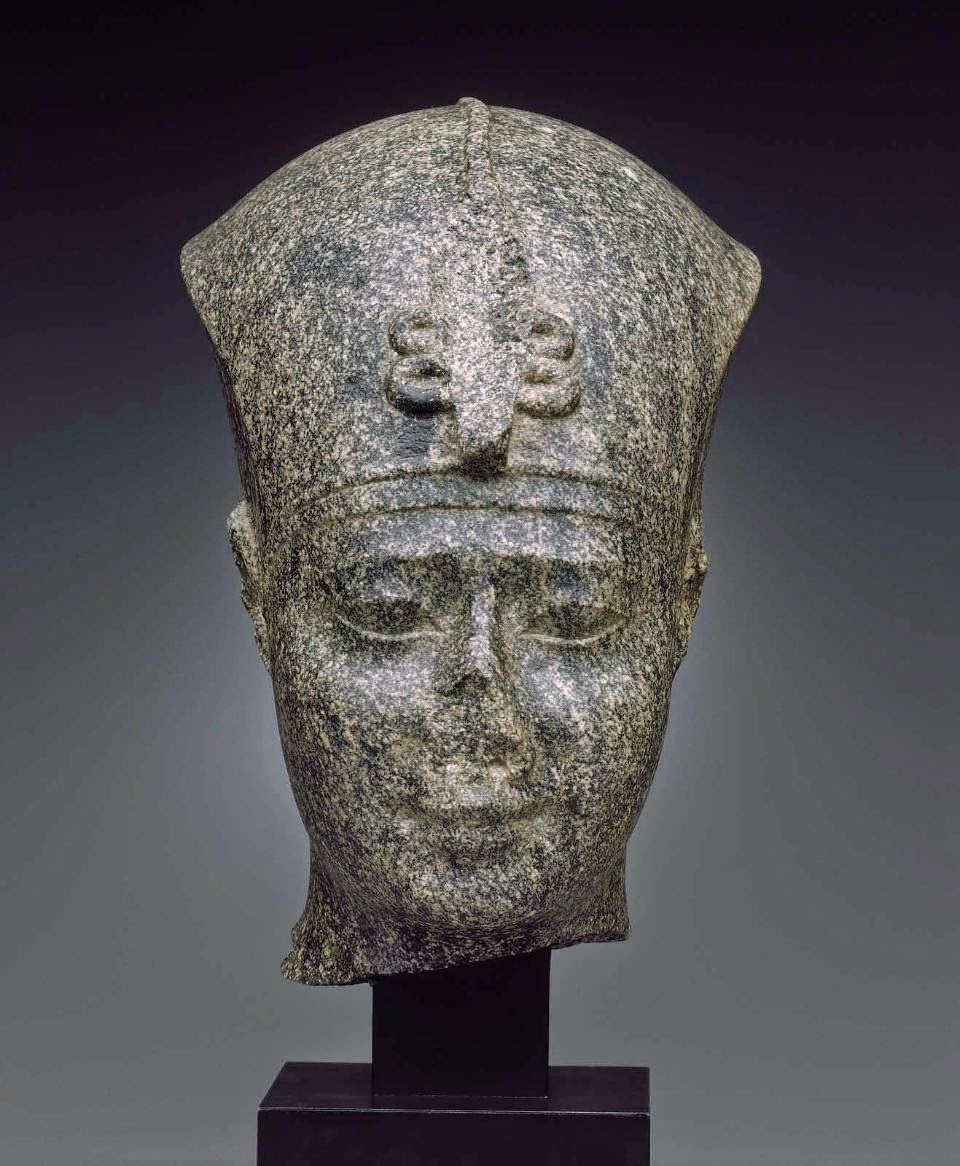
Head of Nectanebo II
Egyptian, Late Period, Dynasty 30, reign of Nectanebo II, 362–343 B.C.
DIMENSIONS
height x width x depth 31 x 24.5 x 24 cm (11 13/16 x 9 5/8 x 9 7/16 in.)
MEDIUM OR TECHNIQUE
Granodiorite
CLASSIFICATION
Sculpture
ACCESSION NUMBER
2000.637
ON VIEW
Egypt: Late Period Gallery - 216
This superb portrait of Egypt’s last native pharaoh is the product of three thousand years’ expertise in carving hard stone. The volumes of his helmet-shaped crown — the Blue Crown, or khepresh, are sleek and streamlined, almost aerodynamic. The artist reveled in the mottled texture of the stone, and polished it to a glistening sheen in a painstaking process reserved for the most important statues.
Nectanebo II was known as the favorite of the gods, renowned for his piety, devotion to the sacred animal cults, lavish gifts of land, restoration of cult statues, and founding of new temples. Thirty sites from the Delta to Elephantine and as far west as Siwa attest to his extraordinary building activity: fourteen completely new structures plus extensions to existing sanctuaries and gifts of temple furniture. Such expenditures would have been remarkable at any time but were particularly so when the country was under constant threat of invasion from the Persians.
In 343 B.C. Nectanebo II was defeated by the Persians. Nothing is known of his death. Legend has it that he escaped to Macedonia. A skilled magician, he appeared to Queen Olympias in her bedchamber disguised as her husband Philip, and sired the future Alexander the Great. It is certain that he was honored under the Ptolemies, for whom he provided an ideal role model as pharaoh. A cult that worshipped Nectanebo II as a divine falcon, the epitome of kingship, persisted at least until the reign of Ptolemy IV.
Source: http://www.mfa.org/collections/object/head-of-nectanebo-ii-272158
Sunday, February 9, 2014
More ancient discoveries in Egypt's Dakahliya
More funerary objects are unearthed inside a mastaba tomb uncovered last week in Dakahliya
by Nevine El-Aref , Sunday 9 Feb 2014
During excavation work carried out Sunday inside a mastaba tomb found in Tel El-Tabila in Dakahliya, a collection of three skeletons, a large collection of ushabti figurines and two tombs were uncovered.
Mohamed Ibrahim, minister of state for antiquities, said in a press release that the three skeletons can be dated to the Late Ancient Egyptian period. A collection of 14 amulets were found buried beside one of them. The most important amulet is one depicting the Triod gods of Amun, Horus and Neftis.
Beside the second skeleton, Ibrahim said, a collection of 29 amulets was found, among them a heart shaped scarab and garnet amulets.
Beside the third skeleton excavators uncovered 12 amulets featuring the Udjat eye of Horus.
Ali El-Asfar, head of the Ancient Egyptian Section at the Ministry of State for Antiquities told Ahram Online that the Egyptian excavation mission uncovered two anthropoid limestone coffins with a mummy inside.
Inside the first coffin the mummy is covered with gilded carttonage and decorated with hieroglyphic text and the cartouche of King Psamtik I from the 26th Dynasty.
The mummy is in a bad state of preservation due to high levels of humidity.
by Nevine El-Aref , Sunday 9 Feb 2014
During excavation work carried out Sunday inside a mastaba tomb found in Tel El-Tabila in Dakahliya, a collection of three skeletons, a large collection of ushabti figurines and two tombs were uncovered.
Mohamed Ibrahim, minister of state for antiquities, said in a press release that the three skeletons can be dated to the Late Ancient Egyptian period. A collection of 14 amulets were found buried beside one of them. The most important amulet is one depicting the Triod gods of Amun, Horus and Neftis.
Beside the second skeleton, Ibrahim said, a collection of 29 amulets was found, among them a heart shaped scarab and garnet amulets.
Beside the third skeleton excavators uncovered 12 amulets featuring the Udjat eye of Horus.
Ali El-Asfar, head of the Ancient Egyptian Section at the Ministry of State for Antiquities told Ahram Online that the Egyptian excavation mission uncovered two anthropoid limestone coffins with a mummy inside.
Inside the first coffin the mummy is covered with gilded carttonage and decorated with hieroglyphic text and the cartouche of King Psamtik I from the 26th Dynasty.
The mummy is in a bad state of preservation due to high levels of humidity.
Sunday, October 6, 2013
Museum Pieces - Coffin of Irthorru
 |
| Photocredit: National Museums Scotland |
Coffin of Irthorru, son of Abzu and Tahir.
Museum reference: A.1910.97
Age: 2,600 years old/6th century BC
Dynasty/Period: Late Period, 26th or 27th Dynasty or later.
Dimensions: Length 178cm/Width 46.5 cm/Depth (lid) 24.5cm /Depth (trough) 17.5 cm
Material: Wood, plastered and painted.
Place of origin: Possibly Meir, Middle Egypt.
Head, torso and sides: The face is painted yellow, with white eyes and a black and a green-striped beard. The top of the head has a red-outlined winged scarab (beetle) pushing a red sun-disc that lies directly above the brow. The wings of the scarab reach down the wig on either side of the face and the upper row of feathers is red and the lower row is green.
A painted collar begins at the upper-arm level and is painted in red and green on a cream ground. It has a dominant triangular pattern ending in a row of alternate yellow and red rosettes and then a row of drop-pendants in green and cream. The hands emerge from the collar and painted yellow.
The sides of the coffin base and lid are decorated with a large cobra with its hood painted in green, stretching down the whole side of the coffin to the feet. It is enclosed by white-bordered bands alternating green and red, with a white central dot, and separated by narrow white and red bars.
Underside of base of coffin: The wig on the base is a solid green and is decorated on the underside with a standing winged goddess, with a red sun-disc on her head and a feather in each hand.
The dominant decorative scheme is a red and green criss-cross motif on a white ground decorated by a central column of text, enclosed by red and green bands.
Source: http://www.nms.ac.uk/highlights/egyptian_coffins/irthorru.aspx
For more coffins and mummy masks: http://www.nms.ac.uk/highlights/egyptian_coffins.aspx
Monday, March 18, 2013
Stephen Ruzicka, Trouble in the West: Egypt and the Persian Empire, 525-332 BCE. - A Bryn Mawr Classical Review
Bryn Mawr Classical Review 2013.03.21
Stephen Ruzicka, Trouble in the West: Egypt and the Persian Empire, 525-332 BCE. Oxford studies in early empires. Oxford; New York: Oxford University Press, 2012. Pp. xxv, 311. ISBN 9780199766628. $74.00.
Reviewed by Anthony J. Papalas, East Carolina University
Egypt of the Pharaohs flourished for over two thousand years. During this period, apart from two incursions, Egypt did not experience major foreign invasions. Its frontiers provided Egypt with excellent natural defensive barriers. Ruzicka’s Trouble in the West: Egypt and the Persian Empire 525-332 BCE deals with the difficulties in conquering Egypt and the problems in holding it. This work begins with Cambyses’s conquest of Egypt in 525 (all dates are BCE) to Alexander’s subjugation of it in 332. Ruzicka argues that Persia’s primary concern in the West was not Greece but Egypt and during these approximate two centuries Persian rule was never secure. His thesis is supported by many costly and often unsuccessful Persian expeditions which were usually triggered by rebellions in the western part of the Delta, a region that the Persians never secured. Ruzicka contrary to reports in Herodotus and in line with recent scholarship argues that initial Persian rule was enlightened. Cambyses did not trample on Egyptian customs nor kill the Apis bull and Darius continued a liberal policy by maintaining low taxes and respecting Egyptian culture. In view of the immenseness of the Persian Empire, some three million square miles, it was practical to win over the people and maintain the area with light garrisons. But after the revolt of 487 Xerxes established a repressive rule and thereafter measures became increasingly oppressive. The Achaemenids, however, tolerated for about a century a strong Egyptian military class, the machimoi, which provided the Persians with military service. The machimoi were among Xerxes’s best soldiers in the Greek invasion of 480 but they eventually became untrustworthy.
Stephen Ruzicka, Trouble in the West: Egypt and the Persian Empire, 525-332 BCE. Oxford studies in early empires. Oxford; New York: Oxford University Press, 2012. Pp. xxv, 311. ISBN 9780199766628. $74.00.
Reviewed by Anthony J. Papalas, East Carolina University
Egypt of the Pharaohs flourished for over two thousand years. During this period, apart from two incursions, Egypt did not experience major foreign invasions. Its frontiers provided Egypt with excellent natural defensive barriers. Ruzicka’s Trouble in the West: Egypt and the Persian Empire 525-332 BCE deals with the difficulties in conquering Egypt and the problems in holding it. This work begins with Cambyses’s conquest of Egypt in 525 (all dates are BCE) to Alexander’s subjugation of it in 332. Ruzicka argues that Persia’s primary concern in the West was not Greece but Egypt and during these approximate two centuries Persian rule was never secure. His thesis is supported by many costly and often unsuccessful Persian expeditions which were usually triggered by rebellions in the western part of the Delta, a region that the Persians never secured. Ruzicka contrary to reports in Herodotus and in line with recent scholarship argues that initial Persian rule was enlightened. Cambyses did not trample on Egyptian customs nor kill the Apis bull and Darius continued a liberal policy by maintaining low taxes and respecting Egyptian culture. In view of the immenseness of the Persian Empire, some three million square miles, it was practical to win over the people and maintain the area with light garrisons. But after the revolt of 487 Xerxes established a repressive rule and thereafter measures became increasingly oppressive. The Achaemenids, however, tolerated for about a century a strong Egyptian military class, the machimoi, which provided the Persians with military service. The machimoi were among Xerxes’s best soldiers in the Greek invasion of 480 but they eventually became untrustworthy.
Tuesday, February 26, 2013
Dynasties Of Egypt Part V: Late Period
Kushite Period, or Dynasty 25 (ca. 712–664 B.C.)
From ca. 728 to 656 B.C., the Nubian kings of Dynasty 25 dominated Egypt. Like the Libyans before them, they governed as Egyptian pharaohs. Their control was strongest in the south. In the north, Tefnakht's successor, Bakenrenef, ruled for four years (ca. 717–713 B.C.) at Sais until Piankhy's successor, Shabaqo (ca. 712–698 B.C.), overthrew him and established Nubian control over the entire country. The accession of Shabaqo can be considered the end of the Third Intermediate Period and the beginning of the Late Period in Egypt.
Nubian rule, which viewed itself as restoring the true traditions of Egypt, benefited Egypt economically and was accompanied by a revival in temple building and the arts that continued throughout the Late Period. At the same time, however, the country faced a growing threat from the Assyrian empire to its east. After forty years of relative security, Nubian control—and Egypt's peace—were broken by an Assyrian invasion in ca. 671 B.C. The current pharaoh, Taharqo (ca. 690–664 B.C.), retreated south and the Assyrians established a number of local vassals to rule in their stead in the Delta. One of them, Necho I of Sais (ca. 672–664 B.C.), is recognized as the founder of the separate Dynasty 26. For the next eight years, Egypt was the battleground between Nubia and Assyria. A brutal Assyrian invasion in 663 B.C. finally ended Nubian control of the country. The last pharaoh of Dynasty 25, Tanutamani (664–653 B.C.), retreated to Napata. There, in relative isolation, he and his descendants continued to rule Nubia, eventually becoming the Meroitic civilization, which flourished in Nubia until the fourth century A.D.
Saturday, July 7, 2012
Persians in Egypt in the Achaemenid period
The last pharaoh of the Twenty-Sixth dynasty, Psamtik (Psammetichus) III, was defeated by Cambyses II (q.v.; 530-22 B.C.E.) in the battle of Pelusium in the eastern Nile delta in 525 B.C.E.; Egypt was then joined with Cyprus and Phoenicia in the sixth satrapy of the Achaemenid empire (Cook, p. 214; Bresciani, Camb. Hist. Iran, pp. 502-03; Briant, 1987; idem, 1992, p. 67). The “first Persian domination” over Egypt (or Twenty-Seventh dynasty) ended around 402 B.C.E. After an interval of independence, during which three indigenous dynasties reigned (the Twenty-Eighth, Twenty-Ninth, and Thirtieth; for the probable last ruler, Khababash, see Ritner; cf. Bresciani, 1990, pp. 637-41), Artaxerxes III (q.v.; 359-38 B.C.E.) reconquered the Nile valley for a brief period (342-32 B.C.E.), usually called the “second Persian domination.”
The first Persian domination. Cambyses led three unsuccessful military campaigns in Africa: against Carthage, the oases of the Libyan desert, and Nubia. He remained in Egypt until 522 B.C.E. and died on the way back to Persia. In contrast to the hostile tradition transmitted by Herodotus (3.64-66) and Diodorus Siculus (1.95), who described Cambyses’ conduct in Egypt as mad, ungodly, and cruel, contemporary Egyptian documents offer a different perspective on this sovereign’s “atrocities” (Posener, pp. 171 ff.; Klasens; Bresciani, Camb. Hist. Iran, pp. 504-05), even though violence and abuses perpetrated by the occupation troops can be taken for granted. Herodotus may have drawn on an indigenous tradition that reflected the Egyptian clergy’s resentment of Cambyses’ decree (known from a text in Demotic script on the back of papyrus no. 215 in the Bibliothèque Nationale, Paris) curtailing royal grants made to Egyptian temples under Amasis (Bresciani, 1981).
Thursday, May 17, 2012
Egypt: The End of a Civilisation
By Dr Aidan Dodson
Defining the end point
The civilisation of ancient Egypt can be traced back in recognisable form to around 3000 BC. It was to endure for over three millennia and it is perhaps the most instantly recognisable of all ancient cultures today. The question of how it came to an end is a perennially popular one, but actually quite difficult to answer, as it is by no means agreed as to what constitutes 'the end' of Egypt as an ancient civilisation.
Is it the definitive end of native Egyptian rule (at least until the 20th century)? In this case the answer would be the flight of King Nectanebo II in 342 BC. Is it Egypt's absorption into the Roman Empire in 30 BC? Or the last appearance of the ancient hieroglyphic script just before AD 400? Or the closure of the last pagan temples in the sixth century?
In many ways the last suggestion is perhaps the most appropriate, as in all the other cases, the core religious and artistic values of the country continued on, albeit increasingly debased and under pressure. However, the demise of the hieroglyphs was a manifestation of the decline and fall of the ancient religion in the face of Christianity, itself ultimately to be supplanted by Islam.
Saturday, February 11, 2012
Amasis: The Pharaoh With No Illusions
John Ray on a ruler who mixed laddishness with mysticism in the last days of independent Egypt.

There is no denying that ancient Egypt arouses great popular interest, but most of the interest concentrates on periods which have visual impact especially the Old Kingdom, the age of the great pyramids, and the New Kingdom, the time of Tutankhamun, Akhenaten, and the splendours of the Egyptian empire. But there are lesser known delights, and one of these is the so-called Late Period, although it passes for early by most people's standards (664 – 330 BC). This period is the subject of increasing interest to scholars, but otherwise it tends to be neglected, partly because of the lack of surviving monuments, partly because of a feeling that Egypt, by this time, had passed its prime and lost its identity along with some of its independence. (The French name for this period, la basse époque, captures this feeling well.) But this is misleading, as becomes clear if we consider the case of Amasis, the last great ruler of the twenty-sixth dynasty, whose reign lasted forty-four years, from 570 to 526 BC.

There is no denying that ancient Egypt arouses great popular interest, but most of the interest concentrates on periods which have visual impact especially the Old Kingdom, the age of the great pyramids, and the New Kingdom, the time of Tutankhamun, Akhenaten, and the splendours of the Egyptian empire. But there are lesser known delights, and one of these is the so-called Late Period, although it passes for early by most people's standards (664 – 330 BC). This period is the subject of increasing interest to scholars, but otherwise it tends to be neglected, partly because of the lack of surviving monuments, partly because of a feeling that Egypt, by this time, had passed its prime and lost its identity along with some of its independence. (The French name for this period, la basse époque, captures this feeling well.) But this is misleading, as becomes clear if we consider the case of Amasis, the last great ruler of the twenty-sixth dynasty, whose reign lasted forty-four years, from 570 to 526 BC.
Friday, December 16, 2011
A Girl and Her Goddess
By
Marie-Astrid Calmettes, Egyptologist
Jessica Kaiser, Osteologist
and Brian V. Hunt
Jessica Kaiser, Osteologist
and Brian V. Hunt
More than 2,500 years ago, a very ill young woman died and was buried at
the already long-abandoned site of the city of the pyramid builders at Giza.
Her grave goods included an amulet of an obscure goddess that suggests the
woman may not have been from the Giza area.
Not only that, but she may not have been of Egyptian descent.
GPMP’s primary investigation at Giza is the 4th dynasty settlement of the
pyramid builders. In one quarter of our dig site, however, we’re faced with the
reality that hundreds of Late Period (747-525 BC) burials and a few Old Kingdom
(2575-2134 BC) burials cover the site above the 4th dynasty levels. We cannot
investigate the older levels without first carefully excavating, recording, and
removing the Late Period burials.
At the end of the 4th Dynasty, the pyramid builders abandoned their city to
the desert sands, as the 5th Dynasty kings moved the workers to Abusir and
Saqqara. Two millennia later, the ancient Egyptians began using the site of the
former Giza workmen’s village to bury their dead. The first of these were
interred on a slope along the western edge of our dig site.
Saturday, October 8, 2011
26th Dynasty tomb discovered by workers digging residential house foundations in Ain Shams
by Nevine El-Aref , Tuesday 4 Oct 2011
Coincidence has always played a major role in discovering important archaeological sites. Among such finds are King Tutankhamen’s tomb on Luxor’s west bank and the golden funerary treasure of King Khufu’s mother Queen Hetepheres on the Giza plateau. Today, coincidence led to the discovery of an unidentified 26th Dynasty tomb in the Ain Shams area.
According to Atef Abul Dahab, head of Ancient Egyptian Antiquities, the tomb was found during routine digging work in Mansheyet Al-Tahrir Street in Ain Shams to lay the foundations of a residential house.
Workers stumbled upon what is believed to be a stony wall engraved with hieroglyphic text.
An archaeological committee from the Supreme Council of Antiquities embarked on an inspection tour and found that the wall is a part of a 26th Dynasty tomb.
Early investigations, said Abul Dahab, reveal that the tomb is empty of any treasured artefacts and inscriptions, which indicate that it had been robbed in antiquity.
Excavation work will continue to inspect the whole area and be sure that it is an empty plot free of any artefacts. The committee will then remove the tomb and hand over the land to its owner.
Subscribe to:
Posts (Atom)