By Laura Geggel, Senior Writer | September 21, 2017
After years of being washed, perfumed and fed in ancient Egypt, the statue of a revered Egyptian deity was given a proper burial with other "dead" statues more than 2,000 years ago, a new study finds.
Ancient Egyptians buried the statue of the deity Ptah — the god of craftsmen and sculptors — with other revered statues, including those of a sphinx, baboon, cat, Osiris and Mut, in a pit next to Ptah's temple.
The statue of Ptah had likely sat in the temple for years, but it and the other sacred objects were respectfully buried after they accumulated damage and were declared useless by the ancient Egyptians, the researchers said.
"We can consider that when a new statue was erected in the temple, this one [of Ptah] was set aside in a pit," said study co-researcher Christophe Thiers, director of the French-Egyptian Center for the Study of the Temples of Karnak. "The other artifacts were also previously damaged during their 'lifetime' in the temple, and then they were buried with the Ptah statue."
Showing posts with label Statuary. Show all posts
Showing posts with label Statuary. Show all posts
Friday, September 22, 2017

Sunday, March 12, 2017
Colossal Statue of Egyptian Pharaoh Discovered in Mud Pit
By Rossella Lorenzi, Live Science Contributor | March 9, 2017
Archaeologists have discovered a colossal statue, possibly depicting Egyptian pharaoh Ramesses the Great, in a muddy pit in a Cairo suburb, Egypt's antiquities ministry announced today (March 9).
Split in fragments, the quartzite statue was found by Egyptian and German archaeologists in the heavily populated Ain Shams and Matariya districts, where the ancient city of Heliopolis — the cult center for sun-god worship — once stood.
Indeed, the statue was found in a courtyard near the ruins of the sun temple founded by Ramses II, better known as Ramesses the Great.
"We found two big fragments so far, covering the head and the chest," said Dietrich Raue, head of the German archaeological team that discovered the statue. "As of yet, we do not have the base and the legs as well as the kilt," Raue told Live Science.
Raue, a curator at the Egyptian Museum of the University of Leipzig, estimates that the statue is about 26 feet (8 meters) tall. Although his team did not find any artifacts or engravings that could identify the subject of the colossal sculpture, its location in front of Ramesses II's temple suggests that it could have belonged to the pharaoh.
Thursday, March 9, 2017
Statue of Amenhotep III, 66 of goddess Sekhmet unearthed in Luxor
The discoveries shed further light on what the eighteenth dynasty pharaoh's temple would have looked like
By Nevine El-Aref , Wednesday 8 Mar 2017
The Colossi of Memnon and Amenhotep III Temple Conservation Project has discovered a magnificent statue in black granite representing king Amenhotep III seated on the throne.
Project director Hourig Sourouzian told Ahram Online that the statue is 248 cm high, 61 cm wide and 110cm deep.
It was found in the great court of the temple of Amenhotep III on Luxor's West Bank.
"It is a masterpiece of ancient Egyptian sculpture: extremely well carved and perfectly polished," Sourouzian said, adding that the statue shows the king with very juvenile facial features, which indicates that it was probably commissioned early in his reign.
A similar statue was discovered by the same team in 2009 and is now temporarily on display in the Luxor Museum of Ancient Egyptian Art.
When the site's restoration is complete, Sourouzian said, the pair of statues would be displayed again in the temple, in their original positions.
Mahmoud Afifi, head of the Ministry of Antiquities Ancient Egyptian antiquities department said the team has discovered up to 66 parts of statues of the goddess Sekhmet this archaeological season. These statues represent the goddess sitting or standing holding a papyrus sceptre and an ankh — the symbol of life.
Wednesday, March 16, 2016
Statues discovered in Amenhotep III temple on Luxor's west bank
A collection of statues depicting the lion goddess Sekhmet was unearthed in the ruins of King Amenhotep III’s funerary temple on Luxor’s west bank
by Nevine El-Aref , Tuesday 15 Mar 2016
A European excavation team working on the funerary temple of King Amenhotep III discovered a set of statues depicting the lioness goddess of war Sekhmet and a partial statue of King Amenhotep III.
Minister of Antiquities Mamdouh Eldamaty told Ahram Online that the newly discovered statues are to be put on display within two months at their original location in the temple after the completion of a wall now under construction around the structure.
Mahmoud Afifi, head of the ancient Egyptian antiquities department, explains that three of the statues are complete figures depicting the goddess Sekhmet sitting on a throne and holding in her right hand the ankh symbol of life.
Another of the statues depicts Sekhmet standing and holding the papyri slogan in her left hand, with a fifth statue depicting a standing King Amenhotep III wearing the official suit of his jubilee.
Sourouzian pointed out that during the last excavation season the mission unearthed a collection artefacts of the goddess Sekhmet wearing the triode wig and a long tide dress.
Source: http://english.ahram.org.eg/NewsContent/9/40/191039/Heritage/Ancient-Egypt/Statues-discovered-in-Amenhotep-III-temple-on-Luxo.aspx
 |
| Photocredit: Ahram Online |
by Nevine El-Aref , Tuesday 15 Mar 2016
A European excavation team working on the funerary temple of King Amenhotep III discovered a set of statues depicting the lioness goddess of war Sekhmet and a partial statue of King Amenhotep III.
Minister of Antiquities Mamdouh Eldamaty told Ahram Online that the newly discovered statues are to be put on display within two months at their original location in the temple after the completion of a wall now under construction around the structure.
Mahmoud Afifi, head of the ancient Egyptian antiquities department, explains that three of the statues are complete figures depicting the goddess Sekhmet sitting on a throne and holding in her right hand the ankh symbol of life.
Another of the statues depicts Sekhmet standing and holding the papyri slogan in her left hand, with a fifth statue depicting a standing King Amenhotep III wearing the official suit of his jubilee.
Sourouzian pointed out that during the last excavation season the mission unearthed a collection artefacts of the goddess Sekhmet wearing the triode wig and a long tide dress.
Source: http://english.ahram.org.eg/NewsContent/9/40/191039/Heritage/Ancient-Egypt/Statues-discovered-in-Amenhotep-III-temple-on-Luxo.aspx
Sunday, May 31, 2015
Museum Pieces - Bronze statuette of the moon god Iah
Bronze statuette of the moon god Iah

EA 12587
The moon god Iah holding the eye of Horus
The god Iah, whose name means 'moon', first appears in the Late Period (661-332 BC). The moon god was assimilated with Osiris, god of the dead. Perhaps because, in its monthly cycle, the moon appears to renew itself. Iah also seems to have assumed the lunar aspect of Thoth, god of knowledge, writing and calculation; the segments of the moon were used as fractional symbols in writing.
Thoth was seen as the intermediary between rage and peace among the gods. According to myth, Thoth was responsible for returning the solar eye to Re after a goddess, variously interpreted as Hathor, Sekhmet or Tefnut, had fled with it to Nubia. At this time the sun-god was ruler on earth and had learned that humans were plotting against him. He decided to send the solar eye to destroy them. After the first day of destruction Re was so sickened with the carnage that he decided to spare mankind. To make the goddess forget her task, Re tricked her by making her drunk with 7000 jars of red-stained beer. When she became sober again she retreated to Nubia in embarrassment. Thoth was sent after her by Re, who eventually coaxed her into returning.
S. Quirke and A.J. Spencer, The British Museum book of anc (London, The British Museum Press, 1992)
Source:
From Egypt
Late Period, after 600 BC
Height: 22.000 cmLate Period, after 600 BC
EA 12587
The moon god Iah holding the eye of Horus
The god Iah, whose name means 'moon', first appears in the Late Period (661-332 BC). The moon god was assimilated with Osiris, god of the dead. Perhaps because, in its monthly cycle, the moon appears to renew itself. Iah also seems to have assumed the lunar aspect of Thoth, god of knowledge, writing and calculation; the segments of the moon were used as fractional symbols in writing.
Thoth was seen as the intermediary between rage and peace among the gods. According to myth, Thoth was responsible for returning the solar eye to Re after a goddess, variously interpreted as Hathor, Sekhmet or Tefnut, had fled with it to Nubia. At this time the sun-god was ruler on earth and had learned that humans were plotting against him. He decided to send the solar eye to destroy them. After the first day of destruction Re was so sickened with the carnage that he decided to spare mankind. To make the goddess forget her task, Re tricked her by making her drunk with 7000 jars of red-stained beer. When she became sober again she retreated to Nubia in embarrassment. Thoth was sent after her by Re, who eventually coaxed her into returning.
S. Quirke and A.J. Spencer, The British Museum book of anc (London, The British Museum Press, 1992)
Source:
Monday, April 6, 2015
Museum Pieces - Statue of Khaemwaset

This statue fragment portrays Khaemwaset, son of Ramesses II and Isetnofret, who was the high priest of Ptah at Memphis. He is often called the 'first archaeologist', and he restored a number of ancient tombs at Memphis and also constructed the Serapeum. He became especially important in the Graeco-Roman Period, and two demotic stories depict him as a master magician. The Brussels statue shows the prince standing, wearing an archaising wig and a false beard. He holds in his hands an indeterminate cult object. Two identical vertical columns of text on the back pillar tell us that the prince was here shown as the god Horus Iunmutef.
Inventory number: E.6721
Dating: RAMESSES II/USERMAATRE-SETEPENRE
Archaeological Site: SAQQARA NECROPOLIS ?
Category: FIGURINE/STATUETTE
Material: BASALT ?
Technique: HEWN; POLISHED; ENGRAVED; SCULPTURED
Height: 25.4 cm
Width: 15.5 cm
Depth: 19.3 cm
Translation
The god Horus Iunmutef, the sem priest, the prince, Khaemwaset, that he might give...
Bibliography
F. Lefebvre et B. Van Rinsveld, L'Égypte. Des Pharaons aux Coptes, Bruxelles 1990, 127-128
W. Seipel, Gott. Mensch. Pharao. Viertausend Jahre Menschenbild in der Skulptur des Alten Ägypten (Exposition), Vienne 1992, 293-295 n° 110
Le Roman de la momie. Les amours d'une princesse égyptienne (Exposition Saint-Gérard de Brogne), Namur 1997, 112 n° 43
Source: http://www.globalegyptianmuseum.org/detail.aspx?id=1096
Sunday, March 15, 2015
Finding the missing pieces
An important restoration of the colossal statue of Amenhotep III and Queen Tiye has been made possible by the discovery of long-missing fragments, writes Zahi Hawass
In 1859, the Frenchman Auguste Mariette found a huge double statue of Amenhotep III and his favourite queen, Tiye. Mariette was the first director of antiquities in Egypt and “discovered” famous monuments like the Serapeum at Saqqara and the Valley Temple of Chephren at Giza.
The statue was found at Medinet Habu, the great temple of Ramses III in western Thebes, near the Roman Court. But the statue originally stood at the great southern gate of the funerary temple of Amenhotep III at Kom Al-Hitan, to the east of Medinet Habu.
When the statue was discovered, many sections of the figures of the king and queen were missing and had to be restored by filling in the gaps. The restoration work was carried out at the turn of the last century, by an Italian artist and restorer. He clearly showed the difference between the original parts of the statue and the restored portions.
The statue is now housed in the Cairo Museum, at the end of the main hall on the ground floor. The king is shown seated, with his hands placed flat on his knees. Queen Tiye sits beside him, with one arm placed around the king’s waist. Between them is a small statue of one of their daughters, perhaps the one who married her brother Akhenaton and was the mother of Tutankhamun.
Sunday, March 8, 2015
Karnak: Excavation yields 38 artifacts
The Centre franco-égyptien d'étude des temples de Karnak (CNRS/Egyptian Ministry of State for Antiquities) has just completed the excavation of a favissa, a pit discovered in early December 2014 near the temple of the god Ptah. The dig has unearthed 38 statues, statuettes and precious objects, making this an exceptional find, both for the quantity and quality of the religious artifacts brought to light. Furthermore, a completely new recording method was used during the dig that makes it possible to virtually reconstruct each step of the discovery with millimeter accuracy.
 |
| Courtesy of CNRS (Délégation Paris Michel-Ange) |
The Centre franco-égyptien d'étude des temples de Karnak (French-Egyptian Center for the Study of the Temples of Karnak -- Cfeetk) was founded by the CNRS and the Egyptian Ministry for Antiquities to study and restore the Amun-Re precinct at Karnak (Luxor). Since October 2008, an interdisciplinary program has been dedicated to the temple of Ptah, located at the northern end of the temple of Amun-Re. Built during the reign of Thutmose III (c.1479 -- c.1424 BC), the temple of Ptah was restored, enlarged and adapted throughout the period before the reign of Emperor Tiberius (14-37 AD). It is dedicated to the god Ptah, a divinity associated with the Egyptian town of Memphis.
The program has entered its second phase, which focuses on archaeology, and the excavations recently uncovered a favissa (repository pit for cultic objects) two meters behind the temple. Here, Cfeetk archaeologists found 38 statues, statuettes and precious objects made of limestone, greywacke, copper alloy and Egyptian frit, sometimes covered in gold. These religious objects had been placed around the lower part of a seated statue of the god Ptah. The find notably included:
- 14 statues, statuettes and figurines of Osiris,
-- 3 statuettes of baboons,
-- 2 statuettes representing the goddess Mut, including one covered in hieroglyphics,
-- 1 head and fragments of a cat statuette (Bastet),
-- 2 unidentified statuette bases,
-- 1 small plaque and the upper part of a small stele marked with the name of the god Ptah,
-- Several inlays (iris, cornea, beards, headdresses, etc.)
A sphinx statue and a small statue head probably representing the god Imhotep were also discovered in the upper part of the pit and fragments of a stele were found at the edge. According to the ceramic material found in the pit and the epigraphic data, this collection of statues dates back to the 8th-7th century BC, which marked the beginning of the 25th Egyptian dynasty.
This discovery is exceptional in Egypt in terms of both size and quality. Another aspect that makes it special is the recording method used during the dig. The excavation of the objects was recorded by a topographer specialized in archaeology who made a series of photogrammetric reconstructions by high-density image correlation, from the discovery of the first object until the complete removal of the statues from the pit. This technique consists in compiling hundreds of photographs taken during the fieldwork to make a virtual 3-D reconstruction of each step of the excavation. By linking these photogrammetric reconstructions with very precise topographical reference points -- to within a few millimeters -- this method makes it possible to locate all the objects after they have been removed and study their layout in detail. It also enabled the scientists to assemble a video of the whole removal operation, which needed to be completed rapidly due to the objects' value, while preserving the data collected on the site as it was discovered.
All the artifacts brought to light are being restored in the Cfeetk laboratory. The excavation is ongoing and could shed light on the organization of the surroundings of the Temple of Ptah -- as well as explain the digging of this outstanding favissa.
Source: http://www.sciencedaily.com/releases/2015/03/150306073818.htm
Sunday, February 8, 2015
Egyptian statuettes of Osiris: Production unveiled by neutrons and laser
Jan 30, 2015 by Inês Crespo
The world's museums exhibit collections of precious artefacts from thousands of years ago. Very often it is the case that not much is known about how those ancient artefacts were created. There is a number of limitations to investigate them as traditional sampling techniques risk damaging the materials. In the search for non-invasive methods, a group of scientists have combined three different techniques to analyse copper alloy figurines. They wanted to know how the figurines were crafted, their composition, and how they are deteriorating.
The figurines were provided by the Egyptian Museum of Florence in Italy. While the year they were created is unknown, we know that the first figurine was brought from Egypt to Italy by the Schiaparelli archaeological expeditions in the 19th century, and the other two figurines were donated to the museum by a noble family in 1868 and 1848. They represent Osiris, the god of the afterlife, the underworld and the dead, with arms and legs bound to the body by mummy bandages, and holding the traditional insignias of kingship: the crook and flail.
An innovative analytical approach
To look inside the figurines, the group conducted high resolution neutron tomography at the Helmholtz-Zentrum Berlin, time of flight neutron diffraction at the ISIS neutron source in the UK, and performed laser induced plasma spectroscopy (LIPS) measurements. Thanks to the NMI3 Access programme their travel and subsistence expenses to Germany were covered.
Thanks to this new approach, these artefacts could be characterised like never before. Even though the figurines are originating from different areas in Egypt the results show that they were all crafted with similar core materials, same alloy compositions, and with a similar method for preparation of the casting mould. The latter was executed starting from forming and firing an earthy core. The wax model for casting was then sculptured on this earthenware core, and eventually the mould was completed with the application of the mantle and the final firing.
This innovative analytical approach proved very successful to analyse ancient artefacts with the big advantage of not being invasive for the artefacts under study. This combination of techniques will be applied to investigate other bronze statuettes of the Egyptian Museum of Florence.
Source: http://phys.org/news/2015-01-egyptian-statuettes-osiris-production-unveiled.html
The world's museums exhibit collections of precious artefacts from thousands of years ago. Very often it is the case that not much is known about how those ancient artefacts were created. There is a number of limitations to investigate them as traditional sampling techniques risk damaging the materials. In the search for non-invasive methods, a group of scientists have combined three different techniques to analyse copper alloy figurines. They wanted to know how the figurines were crafted, their composition, and how they are deteriorating.
The figurines were provided by the Egyptian Museum of Florence in Italy. While the year they were created is unknown, we know that the first figurine was brought from Egypt to Italy by the Schiaparelli archaeological expeditions in the 19th century, and the other two figurines were donated to the museum by a noble family in 1868 and 1848. They represent Osiris, the god of the afterlife, the underworld and the dead, with arms and legs bound to the body by mummy bandages, and holding the traditional insignias of kingship: the crook and flail.
An innovative analytical approach
To look inside the figurines, the group conducted high resolution neutron tomography at the Helmholtz-Zentrum Berlin, time of flight neutron diffraction at the ISIS neutron source in the UK, and performed laser induced plasma spectroscopy (LIPS) measurements. Thanks to the NMI3 Access programme their travel and subsistence expenses to Germany were covered.
 |
| Courtesy of Journal of Analytical Atomic Spectrometry |
This innovative analytical approach proved very successful to analyse ancient artefacts with the big advantage of not being invasive for the artefacts under study. This combination of techniques will be applied to investigate other bronze statuettes of the Egyptian Museum of Florence.
Source: http://phys.org/news/2015-01-egyptian-statuettes-osiris-production-unveiled.html
Sunday, December 14, 2014
Museum Pieces - Diorite bust of Horemheb
 |
| Photocredit: Nicholson Museum |
Diorite bust of Horemheb
Collection: Nicholson Museum: Stone Artefacts, Ancient Egyptian
Object Category: Sculpture - Bust
Name/Title: Fragmentary statue of the pharaoh Horemheb as a kneeling scribe
Media: Stone - diorite
Measurements: 45.5 h/l x 40.0 w x 26.0 d cm, 147 kg
Acquisition Credit Line: Donated by Sir Charles Nicholson 1860
Museum Number: NMR. 1138
Place: Ptah Temple, Memphis, Egypt
Date: 1330-1320 BC
Description:
The figure wears a very fine garment with pleated sleeves and collar at base of the throat. Almost certainly Horemheb from his pre royal career.
History Notes:
Description and Function (Author: Dr Sophie Winlaw)
There are no inscriptions on the surviving section of this statue (including the narrow back pillar - an area which is usually inscribed with the subject's name). However, the identity of this individual can be determined through an examination of his facial features, the distinctive style of sculpture, the clothing and the wig. The long unstructured wavy wig is commonly worn by scribes who are usually represented in statuary as seated figures with crossed legs and in many cases papyrus scrolls on their laps (the fold of skin of our piece below the breast is suggestive of either a seated or squatting figure).
Scribes form a well respected professional class who are literate - unlike the majority of ancient Egyptians - so for this man to be represented as a scribe it reflects his high social status. This is also reflected by the style of wig and the garment he wears - types which were worn by high officials of the late 18th and early 19th dynasties (1550-1213 BC). Scribes are also protected by the god Thoth - the ibis headed god of writing and knowledge.
Many of the scribal statues depict the subject as being bare-chested but in this case he wears a distinctive type of robe which is draped loosely over his upper arms. The facial features are very distinctive, especially the shape of the eyes and the fullness around the jaw line and cheeks (representative of the Amarna Period). This statue has been carved, smoothed and polished with great precision and there would have been few officials who could have afforded a statue of this quality.
Saturday, December 13, 2014
New discoveries at Luxor
By Rany Mostafa:
Tomb of “divine wife of God Amun” unearthed in Luxor
CAIRO: The tomb of “the divine wife of God Amun,” an ancient Egyptian title given only to royal wives, has been discovered at the mortuary temple of Pharaoh Ramses II in the west bank of Luxor, according to Abdel-Hakim Karar, director of the Upper Egypt Antiquities Department, Thursday.
“The tomb is relatively small with a stone door leading to a 5-meter shaft and a burial chamber, where funerary equipments, offerings and 20 well-preserved statuettes were found,” Karar told The Cairo Post Thursday.
The statuettes, found by the tomb’s entrance, bore the name of “Karomama” and hieroglyphic inscriptions describe her as “the earthly spouse of the god Amun,” and we believe she may have been the wife of the 22nd Dynasty’s Pharaoh Osorkon II (872B.C–837B.C.,) said Karar.
The discovery was made by French-Egyptian mission led by Christian Leblanc, a French archaeologist, who has been excavating in the mortuary temple and the tomb of Ramses II since 1980s.
“The new discovery may not be spectacular from the artistic point of view, but due to the scarcity of Karomama’s artifacts that have been discovered so far, it is definitely a significant find as it sheds more light on her life,” Leblanc was quoted by the Pharaoh Magazine Thursday.
Sunday, November 30, 2014
Museum Pieces - A Worshipper Kneeling Before the God Anubis
 |
| Photocredit: Walters Art Museum |
A bronze statuette of the anthropomorphic god Anubis facing a kneeling worshipper. He has the head of a jackal and the body of a human male. The piece has been cast in three sections and then joined. The eyes of Anubis are inlaid with gold and there are traces of gilding on the shoulders, wrists, ankles, neck, wig, and ears. The gilding was delicately applied to the eyes, eyebrows and muzzle, but in other areas it appears to have been applied in a more careless fashion. The piece is well preserved in general but there is a break on the lower back corner of the base and there is some green and bright blue corrosion on the lower side of the base.
A hieroglyphic inscription runs around the main base, the base of the Anubis figure and along the back pillar of the worshiper, identifying the dedicant as one Wdja-Hor-resnet, son of Ankh-pa-khered, who is asking for the blessings of the god Anubis. The figure of Anubis is in a striding position with his proper left leg advanced. His proper right arm hangs at his side and the right hand is clenched into a fist with the thumb protruding. The proper left arm is raised and bent at the elbow and there is a drilled hole in the hand for the insertion of an object. Earlier photographs of this piece in Darresy's "Statues de Divinités," show that the missing object was a "was" scepter. He wears a tripartite wig, "shendyt" kilt with deep pleats and a striated belt. A broad collar, armlets and bracelets are incised and gilded. Anklets are suggested by the gilding around the ankles but they are not incised. The musculature of the limbs and the torso is clearly defined. The ears of the god are large and the inner detailing has been carefully modeled. The muzzle comes to a delicate point, accentuating the skillfully modeled eyes, sweeping brows, nose and mouth.
There are two cobras at the feet of the deity facing the worshipper. The proper right cobra wears the Red Crown of Lower Egypt and the left cobra wears the White Crown of Upper Egypt. The head of the left cobra is raised slightly higher than that of the right. A worshipper kneels before the god with his back against an inscribed pillar which is pyramidal at the top. He kneels with both knees down on a flat rectangular base, which is attached to the larger main base below. He extends his hands to the god palms down. He wears a "shendyt" kilt, but the pleats are not carved with the same precision that is seen on the kilt of the god. The bent knees are squared off unnaturally and the legs blend together below the kilt. He has an inscribed broad collar. He also wears a skull cap, the front line of which is clearly marked across his brow. The face is round with full cheeks and no definition of the chin. The ears are large and set high. The eyes are natural and do not have cosmetic brows. The nose is straight and the mouth is small with slightly pursed lips. The overall surface of the worshipper is pitted whereas the figure of Anubis has a high polish.
[Translation] May Anubis, give life, health, long life and great and good old age to Wdja-Hor-resnet, son of Ankh-pa-khered, whose mother is Ta-gemiw(t), who is born (made) of the Mistress of the house, Hy-inty for Pen-pa-djew./ May Anubis give life to Wdje-hor-resnet, son of Ankh-pa-khered./ May Anubis, who is before the place of the divine booth, give life, health, strength, a long life, and a great old age and happiness to the son of Ankh-pa-khered, whose mother is Ta-gemiw(t), who is Mistress of the House, Hy-inty for Pen-pa-djew.
Acquired by Henry Walters, 1930
PERIOD: ca. 747-525 BCE (Third Intermediate Period-Late Period, 25th-26th dynasty)
MEDIUM: bronze with gilt, gold inlay
ACCESSION NUMBER: 54.400
MEASUREMENTS: H: 8 3/16 x W: 5 11/16 x D: 2 1/16 in. (20.8 x 14.4 x 5.3 cm)
Read more about Anubis...
Sunday, November 2, 2014
Museum Pieces - Statuette of Imhotep
Statuette of Imhotep
Category: Sculpture in the round, figurines / statuettes, human / gods and goddesses figurines
Date: Ancient Egyptian period, Late Period (664-332 BCE)
Provenance: Upper Egypt, Giza, Saqqara
Material(s): Non-organic material, alloy, bronze
Height: 14.5 cm
Registration Number(s): BAAM Serial 0591, CG 38873
Description
A bronze statue of Imhotep sitting with his hands resting on his knees holding a papyrus roll. This Late Period statue was found in Saqqara.
Imhotep
Imhotep was the famous architect and vizier of King Djoser of the Third Dynasty (Old Kingdom) who built the Saqqara complex and the step pyramid. Manetho ascribes to him the innovation of building in dressed stone. His name was found inscribed on a statue belonging to King Djoser in the Saqqara step-pyramid complex bearing his titles. He was 'the builder, sculptor and maker of stone vases'; the 'royal chancellor, first under the king, ruler of the great mansion, member of the Pat, greatest of seers, and overseer of masons and painters'.
During the New Kingdom, new titles were added to him, such as 'High Priest', the 'Sage', 'Chief Scribe' and 'Son of the god Ptah.
Imhotep, while honoured during his lifetime, was deified two thousand years after his death in the Late (Saite) Period and was considered the god of wisdom, writing and medicine. He was linked to the gods Ptah and Thoth.
The Greeks associated him with their god of medicine, Asklepius. His cult centre at Saqqara (the Asklepion) became a pilgrimage centre for those seeking healing. He was also worshipped at temples of Deir El Medina, Karnak, Deir El Bahari and Philae.
It is believed that his tomb lies in the northern part of the Saqqara necropolis, however, it has not been found to date.
Bibliography
Corteggiani, Jean Pierre. L'Egypte des Pharaons au Musée du Caire. Paris: Hachette, Les Livres de France, 1986.
"Imhotep". In Dictionary of Egyptian civilization. By Posener, Georges, Serge Sauneron and Jean Yoyotte. Translated from the French by Alix Macfarlane. London: Methuen, 1962.
Source: http://antiquities.bibalex.org/Collection/Detail.aspx?collection=38&a=591&lang=en#
Photocredit: BA Antiquities Museum/C. Gerigk
 |
Date: Ancient Egyptian period, Late Period (664-332 BCE)
Provenance: Upper Egypt, Giza, Saqqara
Material(s): Non-organic material, alloy, bronze
Height: 14.5 cm
Registration Number(s): BAAM Serial 0591, CG 38873
Description
A bronze statue of Imhotep sitting with his hands resting on his knees holding a papyrus roll. This Late Period statue was found in Saqqara.
Imhotep
Imhotep was the famous architect and vizier of King Djoser of the Third Dynasty (Old Kingdom) who built the Saqqara complex and the step pyramid. Manetho ascribes to him the innovation of building in dressed stone. His name was found inscribed on a statue belonging to King Djoser in the Saqqara step-pyramid complex bearing his titles. He was 'the builder, sculptor and maker of stone vases'; the 'royal chancellor, first under the king, ruler of the great mansion, member of the Pat, greatest of seers, and overseer of masons and painters'.
During the New Kingdom, new titles were added to him, such as 'High Priest', the 'Sage', 'Chief Scribe' and 'Son of the god Ptah.
Imhotep, while honoured during his lifetime, was deified two thousand years after his death in the Late (Saite) Period and was considered the god of wisdom, writing and medicine. He was linked to the gods Ptah and Thoth.
The Greeks associated him with their god of medicine, Asklepius. His cult centre at Saqqara (the Asklepion) became a pilgrimage centre for those seeking healing. He was also worshipped at temples of Deir El Medina, Karnak, Deir El Bahari and Philae.
It is believed that his tomb lies in the northern part of the Saqqara necropolis, however, it has not been found to date.
Bibliography
Corteggiani, Jean Pierre. L'Egypte des Pharaons au Musée du Caire. Paris: Hachette, Les Livres de France, 1986.
"Imhotep". In Dictionary of Egyptian civilization. By Posener, Georges, Serge Sauneron and Jean Yoyotte. Translated from the French by Alix Macfarlane. London: Methuen, 1962.
Source: http://antiquities.bibalex.org/Collection/Detail.aspx?collection=38&a=591&lang=en#
Photocredit: BA Antiquities Museum/C. Gerigk
Sunday, September 7, 2014
Museum Pieces - Block statue of Nes-Amun
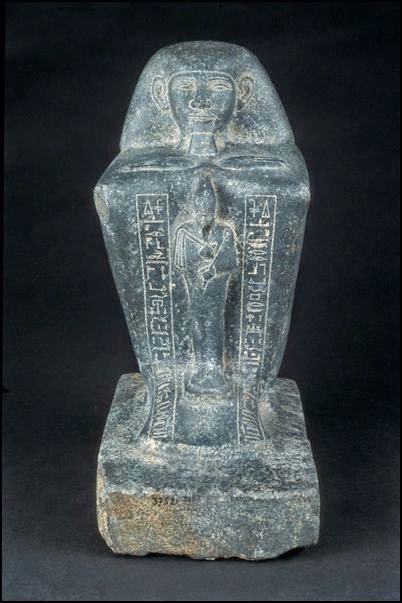 |
| Photocredit: BA Antiquities Museum/C. Gerigk |
Category: Sculpture in the round, statues, human / gods and goddesses statues, block (cube) statues
Date: Late Period (664-332 BCE)
Provenance: Upper Egypt, Luxor (Thebes), East Bank, Karnak temple
Material(s): Rock, granite, black granite
Height: 46 cm; Width: 20.5 cm; Depth: 29.5 cm
Inventory#: BAAM Serial 0598
Description
Block statue of a priest serving the god Montu in Thebes by the name of "Nes Amun" which was found in a cache in Karnak. The priest is represented in a squatting position and a relief sculpture of the god of the dead, Osiris in mummified form and wearing the white crown of Upper Egypt, occupies the centre of the statue. The god Osiris holds the crook and flail, emblems of power and government. Hieroglyphs in two vertical lines on the sides glorify him. The back of the statue also contains hieroglyphs divided into two horizontal lines which read from right to left representing a dedication from the priest and prayers for his soul.
The Priesthood
The priest in ancient Egypt was considered a servant of the god and he was therefore referred to as Hem-Neter, Hem literally meaning servant, Neter meaning god. He was attached to a temple to look after the needs of the god in terms of food and clothing. During the Old and Middle Kingdoms, some priests worked only part-time at the temple and returned to their ordinary everyday family life and occupation after a stint lasting three months in the temple compound (one month in every four per year).
Priests were divided into different ranks and had different duties within the temple, such as attending to offerings and minor parts of temple ritual, or running the economic affairs and administration of the temple, while only the chief priest was allowed to handle the cult image. This high rank of priesthood was not limited to men only, as women from the elite also filled the role of chief priestess. They were called Hemet-Neter and during the Old and Middle Kingdom served the goddess Hathor.
The chief priest exercised great power and influence on Pharaoh and ordinary people alike. During the 18th Dynasty (1550-1295), the god Amun gained supremacy over other gods and as a result, the Amun priesthood dominated the religious landscape and became exceedingly powerful.
The lowest or entry rank among priests was that of Waab, or 'purifier' who was entrusted with the purification and cleanliness of ritual area and items, however, he was not allowed into the inner sanctuary. Another rank of priesthood was that of astrologer/ astronomer which was in charge of divination and of calculating time and setting the calendar determining religious festivals, as well as lucky and unlucky days.
Other priests attached to the "House of Life" or 'Per-Ankh' were responsible for teaching religious matters, writing and for copying texts. The Hery Heb or lector priests recited the words of the god. They were part of the permanent staff at the temple.
Every temple had its retinue of singers and musicians to perform during festivals and rituals. Women among the nobles had the title of "singer or chantress of Amun" and were shown holding or shaking the musical instrument called sistrum during ceremonial activities.
There were other priests involved with healing, with oracles, those who were able to communicate with the dead (mainly women called Rakhet) and those workers of protective magic.
Priests were not allowed to wear wool or leather products, only clothes made of high-quality linen and sandals made of Papyrus, with the exception of the Sem priests who wore a cheetah skin. The latter performed the 'Opening of the Mouth' ceremony during the mummification process.
Priests inherited their role from their fathers, and by the Roman period it was common for the office to be bought. The role of priests in small provincial temples remained less important than in larger ones.
Bibliography
"Priests". In The Oxford Encyclopedia of Ancient Egypt. Edited by Donald B. Redford. Vol. III. New York: Oxford University Press, 2001.
"Priests". In Dictionary of Egyptian civilization. By Posener, Georges, Serge Sauneron and Jean Yoyotte. Translated from the French by Alix Macfarlane. London: Methuen, 1962.
Source: http://antiquities.bibalex.org/Collection/Detail.aspx?lang=en&a=598
Sunday, August 10, 2014
Museum Pieces - Kneeling Amenhotep III as the god Neferhotep
Kneeling Amenhotep III as the god Neferhotep
DIMENSIONS
Height x width x depth: 13 x 3.8 x 5.3 cm (5 1/8 x 1 1/2 x 2 1/16 in.)
MEDIUM
Glazed steatite
CLASSIFICATION
Sculpture
ACCESSION NUMBER
1970.636
PERIOD
1390–1352 B.C.
There is more to this charming statuette of Amenhotep III than meets the eye. The king is wide-eyed, innocent-looking, and decidedly chubby, his bare chest revealing his baby fat. But despite his youthful appearance, Amenhotep III was no child when this statue was created, for it is one of a number of closely related statuettes made in celebration of the king's thirty-year jubilee. Thirty years symbolized a generation, and during the celebration of the jubilee, the king was born again. Amenhotep III would have been at least in his forties at the time, but he appears as a child in token of his spiritual rebirth. The inscription on the back of the statuette calls Amenhotep III, "the son of Isis, who dwells in Edfu," so presumably the figure was placed in the temple of Edfu as an offering to Isis. True to his name, the king kneels to present an offering, now lost, to his mother.
The statuette's distinctive headdress - a round curly wig with uraeus, surmounted by the Double Crown of Upper and Lower Egypt - identifies the ruler with the child god Neferhotep. The crowns were meant to confer stability, while implicit in any child god is the prospect of a new beginning full of promise. The statuette is thus a visual pun, and even the color added to its symbolism. Originally, the figure was glazed a lustrous blue-green, now almost entirely worn away. In ancient Egypt as today, to be green meant to be young; in ancient Egyptian, the words for "green" and "to be young," renput and renpy, had the same root. Additional meaning is provided by the word for glazed material, tjehenet, "dazzling, luminous," which was also applied to sunlight, and by extension, to gold. In this image of himself as the child god Neferhotep, Amenhotep III - who liked to call himself the "dazzling sun-disk of all lands" - found the perfect form of self-expression.
Source: http://www.mfa.org/node/9457
 |
| Photocredit: Museum of Fine Arts, Boston |
DIMENSIONS
Height x width x depth: 13 x 3.8 x 5.3 cm (5 1/8 x 1 1/2 x 2 1/16 in.)
MEDIUM
Glazed steatite
CLASSIFICATION
Sculpture
ACCESSION NUMBER
1970.636
PERIOD
1390–1352 B.C.
There is more to this charming statuette of Amenhotep III than meets the eye. The king is wide-eyed, innocent-looking, and decidedly chubby, his bare chest revealing his baby fat. But despite his youthful appearance, Amenhotep III was no child when this statue was created, for it is one of a number of closely related statuettes made in celebration of the king's thirty-year jubilee. Thirty years symbolized a generation, and during the celebration of the jubilee, the king was born again. Amenhotep III would have been at least in his forties at the time, but he appears as a child in token of his spiritual rebirth. The inscription on the back of the statuette calls Amenhotep III, "the son of Isis, who dwells in Edfu," so presumably the figure was placed in the temple of Edfu as an offering to Isis. True to his name, the king kneels to present an offering, now lost, to his mother.
The statuette's distinctive headdress - a round curly wig with uraeus, surmounted by the Double Crown of Upper and Lower Egypt - identifies the ruler with the child god Neferhotep. The crowns were meant to confer stability, while implicit in any child god is the prospect of a new beginning full of promise. The statuette is thus a visual pun, and even the color added to its symbolism. Originally, the figure was glazed a lustrous blue-green, now almost entirely worn away. In ancient Egypt as today, to be green meant to be young; in ancient Egyptian, the words for "green" and "to be young," renput and renpy, had the same root. Additional meaning is provided by the word for glazed material, tjehenet, "dazzling, luminous," which was also applied to sunlight, and by extension, to gold. In this image of himself as the child god Neferhotep, Amenhotep III - who liked to call himself the "dazzling sun-disk of all lands" - found the perfect form of self-expression.
Source: http://www.mfa.org/node/9457
Sunday, May 18, 2014
Museum Pieces - Limestone statue of Amenemhat III
 Title/s:
Shelly limestone statue of Amenemhat III
Dimensions:
length 12 cm
width 14.3 cm
Period:
Twelfth Dynasty
Middle Kingdom
Date:
circa 1831 B.C. — 1786 B.C.
Material/s:
shelly limestone
Accession Number:
E.2.1946 (Antiquities)
Description:
Head of king Amenemhat III, wearing nemes headdress. Only the shoulders and head are preserved; the base is modern. The statue was found in a private tomb. The facial features are a softer version of the so-called 'realistic portraits' of Senwosret III. In this way the ruler was able to promote a visual link to his predecessor.
This small but forceful head is a fragment from a statue of one of the most important monarchs of Egypt’s 12th dynasty. It is remarkable for its individuality, its suggestion of humanity as well as absolute, divine power.
Amenemhat III here wears the royal nemes headcloth, made of striped linen and bound tightly round his head. On his brow is the uraeus – the cobra symbol. This was used to represent many goddesses, perhaps most frequently Wadjet, protectress of Lower Egypt. Here it probably also represents the eye of the sun god Re, protector of the king.
In ancient Egypt the king was not only the representative of the gods on earth, he was the living embodiment of the deity Horus. Just as Horus had avenged his father Osiris by vanquishing his evil uncle Seth, and saved the lands of Egypt from disorder and chaos, so the king maintained the universal order – maat – and oversaw the continued good government of the country, ensuring harmony between the two lands of Upper and Lower Egypt.
Though small, the sculpture manages to convey the great power of the individual represented. The king's eyes look down as though from an elevated position, his mouth is determined and strong. The dark green limestone, dappled with lighter fossils, gives him a distant, otherworldly appearance.
But the sculptor here also brilliantly suggests the fleshly qualities of Amenemhat. His ears are large and protruding, lines run from his nose to the corners of his mouth, the lips are full and prominent, and there is a sense of the bone structure beneath the skin. This expressive individualism contrasts strongly with the idealised features.
But while the modern viewer might imagine that the statue is a faithful reproduction of the king's actual features, this is unlikely. Egyptian portraiture was concerned more with presenting the idea of a king, than any facts about his physical appearance. Facial lines, for instance, might suggest wisdom through age. Rolls of fat on statues of private individuals might indicate wealth. This portrait of the king is psychological rather than realistic.
The Fitzwilliam also owns the head from a colossal granite statue of Amenemhat III’s father and predecessor, Senwosret III, [E.37.1930]. Though considerably more damaged than the smaller sculpture of his son, we can discern in this a similar attempt to suggest the naturalistic structure of a human face as well as the power of a divine king. The heavy lidded eyes are deep set, there are faint bags beneath them, the mouth is turned down at the corners. His son’s image is, if not identical, then certainly comparable. The similarity of the two kings' official images might suggest a similarity in their approach to government. It suggests that Amenemhat is keen to link himself to his illustrious predecessor.
Many statues survive from the prosperous reigns of these two kings, who both built extensively. Many of these images would have been placed in temples, reminders of the important role the king played in Egyptian religion. But they were also instrumental in consolidating earthly power. Senwosret III’s 39 year reign saw a complete reorganisation of Egypt’s internal administration to secure his own absolute authority as monarch. The political power of important families in the provinces was reduced. Perhaps this new way of representing the king, which was followed by his son, underlined the new political order.
The head of Amenemhat III was found in rather unusual circumstances by Lord Grenfell, who was commander-in-chief of the British garrison in Egypt between 1882 and 1892. A keen Egyptophile, Grenfell unearthed this fragment of a royal statue in the unlikely context of a private tomb. It is thought that it might have been accidentally deposited there when the tomb was robbed, either in antiquity or in modern times.
Sources:
http://www.fitzmuseum.cam.ac.uk/dept/ant/egypt/gallery/cataloguedetail.html?&priref=61606&_function_=xslt&_limit_=350
http://www.fitzmuseum.cam.ac.uk/pharos/collection_pages/ancient_pages/E.2-1946/FRM_TXT_SE-E.2-1946.html
Thursday, December 1, 2011
Statue of Egyptian king Amenhotep III found
CAIRO (AP) -- Egyptian
archaeologists have unearthed a large statue of king Amenhotep III who ruled
nearly 3,400 years ago and who was the grandfather of the famed boy-pharaoh
Tutankhamun.
The Supreme Council of Antiquities says the latest find was made at the king's
funerary temple in the southern city of Luxor.
Thursday's statement says the 44 feet (13.5 meter) tall statue is made of
colored quartzite. It is composed of several large pieces that once put
together will depict the king as standing.
Amenhotep III ruled from 1390-1352 B.C.
The latest find comes after several other relics of the king were
unearthed last year in his mortuary temple on the west bank of the Nile River
in Luxor.
|
Monday, October 31, 2011
Royal Statuary through Old and Middle Kingdom Egypt
This
article covers the trends through Egyptian royal statuary through the Old and
Middle Kingdoms. It shows how the changes in society, in attitude and
structure, drove these artistic trends.
by Lorna
Phillips
Many changes occurred in the Old and
Middle Kingdoms in Egypt, especially in relation to the attitude of the people
towards the king. The trends in royal statuary during this time reflect these
fluctuations in society, both physically and in their purpose. One of the main
physical changes in royal statues was the development of portraiture. The
sculptors had to try and accomplish a sense of naturalism yet still show the
magnificence of the king.
Throughout
Egyptian history, the statuary of royals has had a firm funerary grounding.
This is definitely true for the Old Kingdom, as it was still strongly believed
that the statue could hold divine power and was a place for the king’s ka
(spirit) whilst he was in the afterlife. As they were sacred items, most were
hidden away, often in a serdab, and were the focus for the cults of the dead
kings as a link between the living and the dead. Although they could not see
the statue, it gave them something solid upon which to focus their worship.
According to Cyril Aldred, the statues were purely practical, not aiming to be
emotional for the viewer, as the viewer was not for whom the statue was made.
The statuary of this time was focussed only on the deceased and their needs.
Even though
the statues continued to be associated with the king after his death, during
the Middle Kingdom they also began to represent the king while he was still
alive. The kings of the Middle Kingdom had not emerged from the unrest of the
First Intermediate Period with full support. Statues were therefore placed in
temples around Egypt as monuments, aiming to remind the people of the king’s
dominance. Through this worship, the bonds between the king and the local
communities strengthened.
Subscribe to:
Posts (Atom)